03

Learning with Place

At Melbourne Girls Grammar Early Learning Centre, the ripples of our learning extend far beyond the classroom walls, unfolding through our relationships with the wider community. Our regular visits across the road to the Royal Botanic Gardens create rich opportunities for children and teachers to engage with the living world – sparking curiosity, wonder and a deepening sense of connection. In these moments, children are not simply learning about nature; they are learning with it, as they begin to see themselves as part of a shared and living world.

Our relationship with the Royal Botanic Gardens is not new. For over a century, MGGS students have formed close connections with this incredible place. In today’s context, this relationship holds renewed significance. In an era shaped by climate change, environmental degradation and the ongoing legacies of colonialism, the Gardens can be understood as a pedagogical contact zone – one that calls for ecological literacy, relational ethics and diverse ways of knowing and being.

This is what we describe as Learning with Place. Drawing on the Learning with Place© framework developed by Iorio and Hamm at the University of Melbourne, this approach foregrounds reciprocity, interconnectedness and respect, recognising that children, teachers and schools are deeply entangled with the land, environment and community in which they learn.

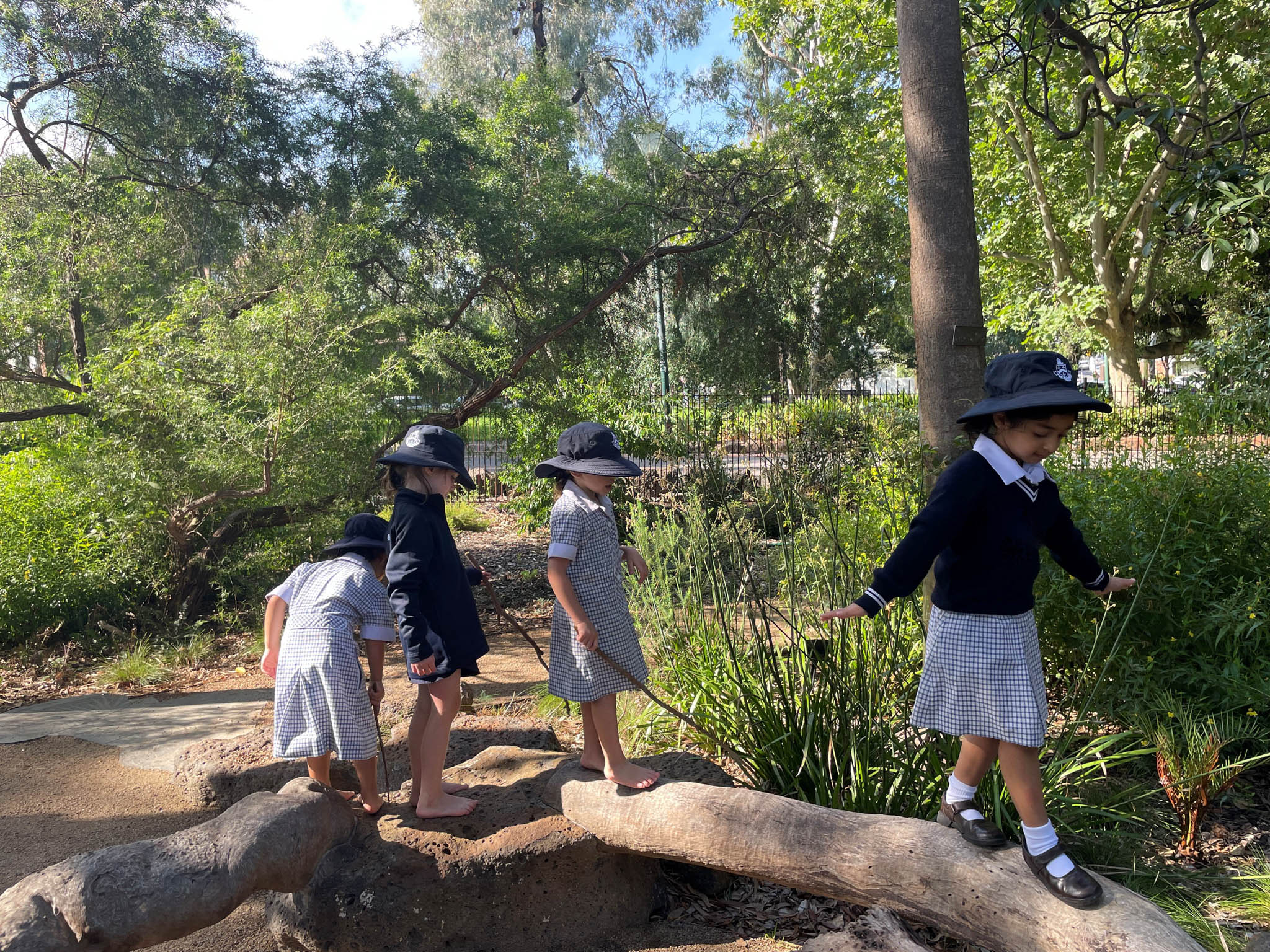
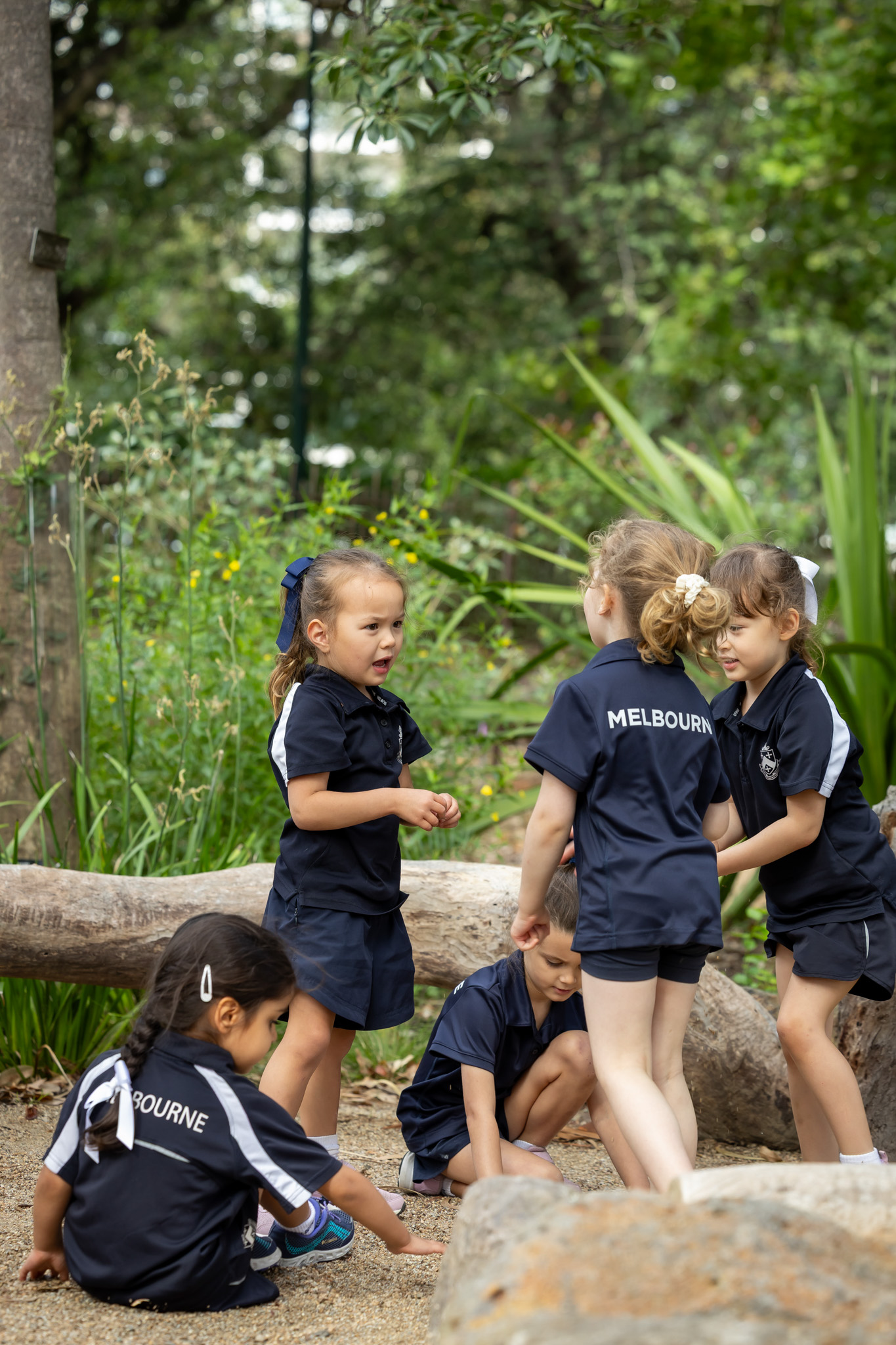
A growing number of our children are growing up in apartments in and around the city, with limited access to expansive natural play environments. As a five-day-a-week early learning centre, this means that MGGS ELC teachers enact deep care for the wellbeing for students through responsive curriculum development, by thoughtfully designing opportunities that meet children’s developmental, physical and creative needs. In this sense, our engagement with the Gardens aligns with principles drawn from play theories – offering children access to rich, open-ended environments where they can explore, have adventures, create and encounter the unexpected (think swans with cygnets and owlets, giant water lillies and sparkly rain drop covered spiderwebs). The Gardens become a vital extension of our learning environment: a place for climbing, building, imagining and connecting, where play and learning are deeply intertwined. In this way, MGGS’s ongoing and enduring relationship with the Royal Botanic Gardens offers children the kind of rich, connected and wonder-filled childhood we wish for all children, everywhere.
Our relationship with the Royal Botanic Gardens is not new. For over a century, MGGS students have formed close connections with this incredible place. In today’s context, this relationship holds renewed significance. In an era shaped by climate change, environmental degradation and the ongoing legacies of colonialism, the Gardens can be understood as a pedagogical contact zone – one that calls for ecological literacy, relational ethics and diverse ways of knowing and being.

This is what we describe as Learning with Place. Drawing on the Learning with Place© framework developed by Iorio and Hamm at the University of Melbourne, this approach foregrounds reciprocity, interconnectedness and respect, recognising that children, teachers and schools are deeply entangled with the land, environment and community in which they learn.

A growing number of our children are growing up in apartments in and around the city, with limited access to expansive natural play environments. As a five-day-a-week early learning centre, this means that MGGS ELC teachers enact deep care for the wellbeing for students through responsive curriculum development, by thoughtfully designing opportunities that meet children’s developmental, physical and creative needs. In this sense, our engagement with the Gardens aligns with principles drawn from play theories – offering children access to rich, open-ended environments where they can explore, have adventures, create and encounter the unexpected (think swans with cygnets and owlets, giant water lillies and sparkly rain drop covered spiderwebs). The Gardens become a vital extension of our learning environment: a place for climbing, building, imagining and connecting, where play and learning are deeply intertwined. In this way, MGGS’s ongoing and enduring relationship with the Royal Botanic Gardens offers children the kind of rich, connected and wonder-filled childhood we wish for all children, everywhere.

Our relationship with the Royal Botanic Gardens is not new. For over a century, MGGS students have formed close connections with this incredible place. In today’s context, this relationship holds renewed significance. In an era shaped by climate change, environmental degradation and the ongoing legacies of colonialism, the Gardens can be understood as a pedagogical contact zone – one that calls for ecological literacy, relational ethics and diverse ways of knowing and being.

This is what we describe as Learning with Place. Drawing on the Learning with Place© framework developed by Iorio and Hamm at the University of Melbourne, this approach foregrounds reciprocity, interconnectedness and respect, recognising that children, teachers and schools are deeply entangled with the land, environment and community in which they learn.

A growing number of our children are growing up in apartments in and around the city, with limited access to expansive natural play environments. As a five-day-a-week early learning centre, this means that MGGS ELC teachers enact deep care for the wellbeing for students through responsive curriculum development, by thoughtfully designing opportunities that meet children’s developmental, physical and creative needs. In this sense, our engagement with the Gardens aligns with principles drawn from play theories – offering children access to rich, open-ended environments where they can explore, have adventures, create and encounter the unexpected (think swans with cygnets and owlets, giant water lillies and sparkly rain drop covered spiderwebs). The Gardens become a vital extension of our learning environment: a place for climbing, building, imagining and connecting, where play and learning are deeply intertwined. In this way, MGGS’s ongoing and enduring relationship with the Royal Botanic Gardens offers children the kind of rich, connected and wonder-filled childhood we wish for all children, everywhere.

"The Gardens become a vital extension of our learning environment: a place for climbing, building, imagining and connecting, where play and learning are deeply intertwined."

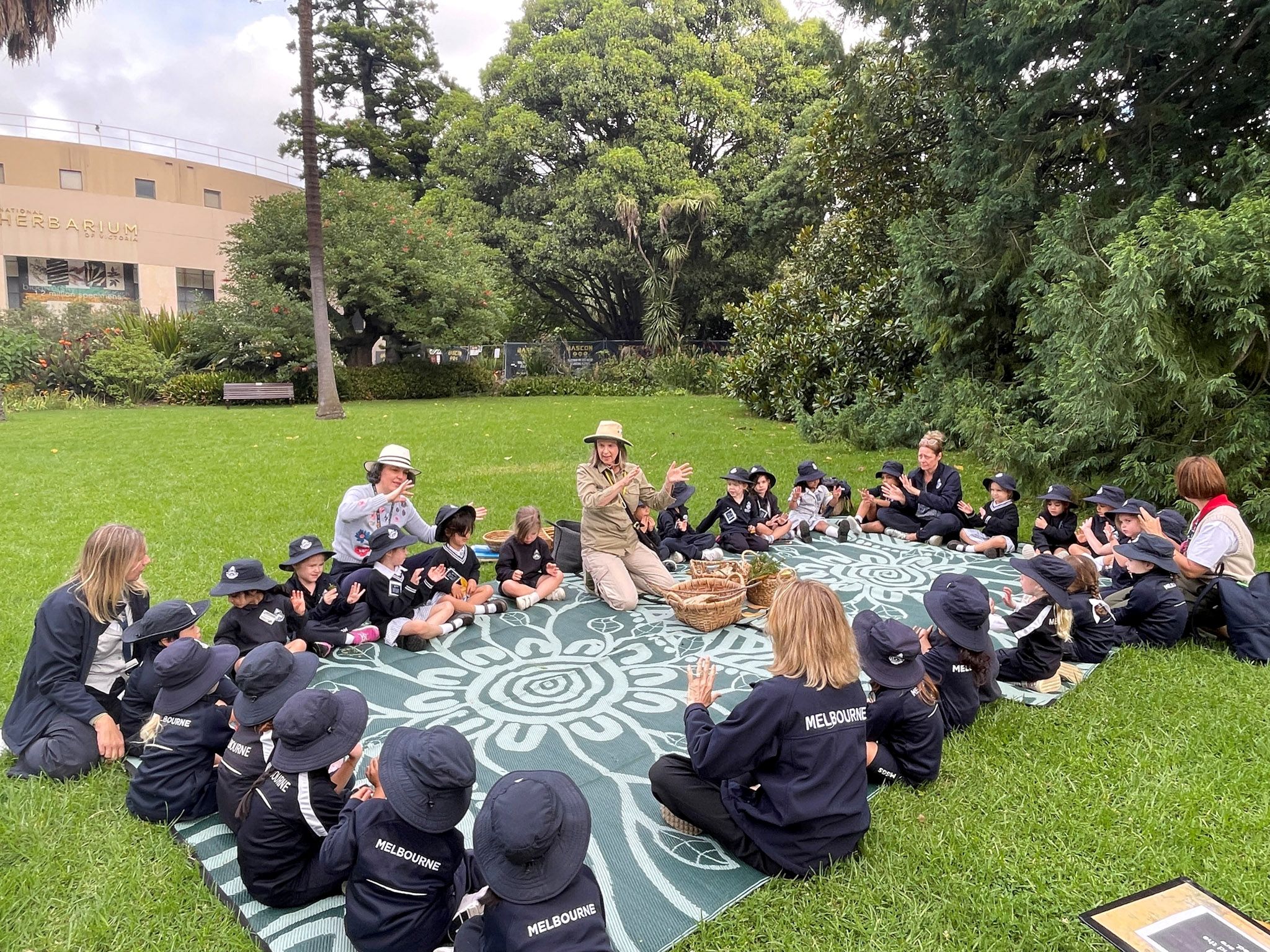
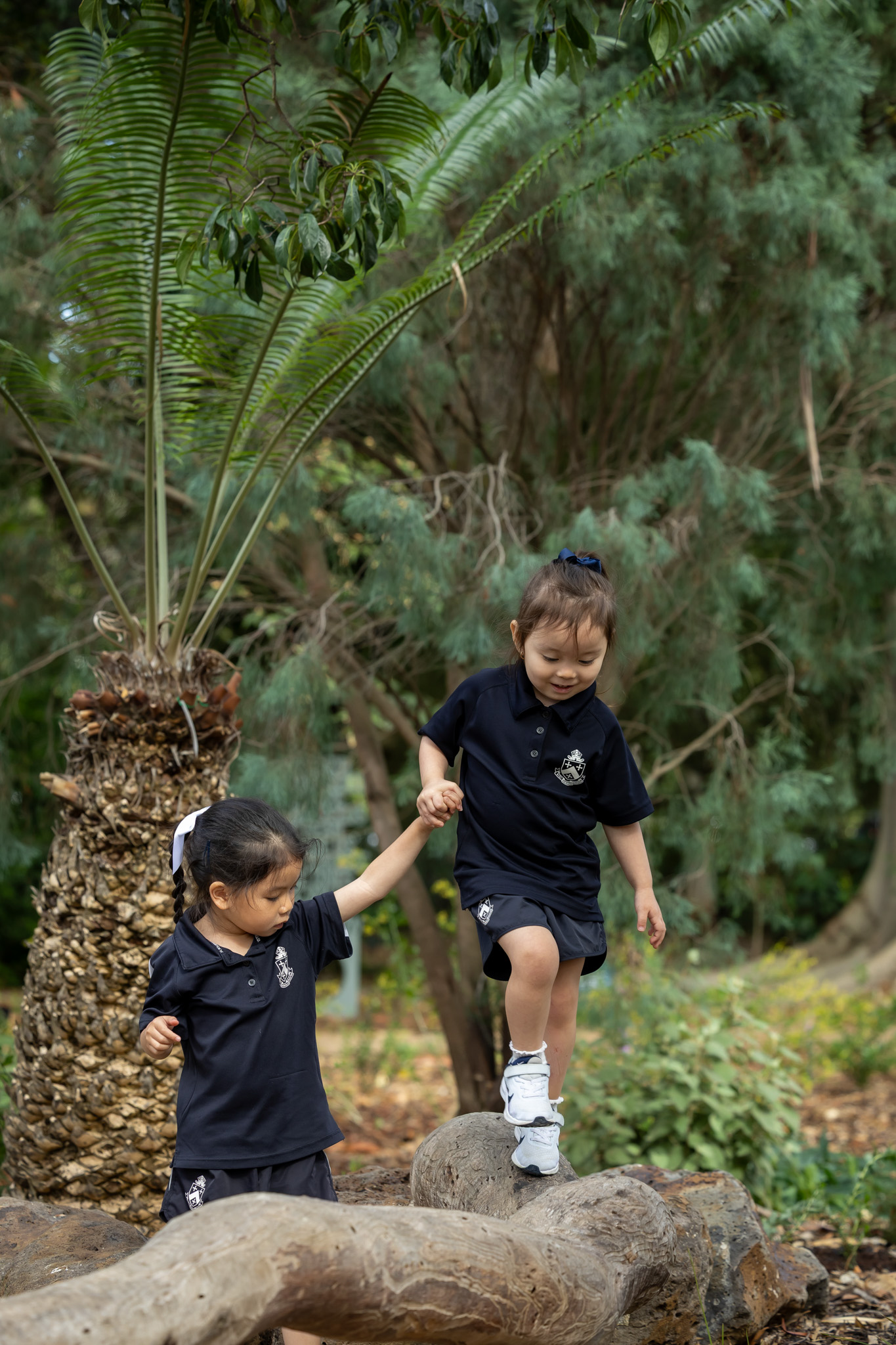
During last year’s ELC inquiry into Place, we drew on First Nations scholar and Noonuccal women Karen Martin’s (2016) concept of Coming Alongside, we approached the Gardens not as something to be explored or used, but as a place we enter into relationship with – respectfully, attentively and with humility. For our four-year-old learners, this is supported through a pedagogy of slowing down, inspired by the First Nations concept of Dadirri – deep listening and quiet, still awareness (Ungunmerr-Baumann et al., 2022). As we walk through the Gardens, we pause often. Children sit with and in trees, watch the movement of water, and listen to birdsong carried by the wind. In these moments, learning is not hurried. Instead, children are invited to attune – to notice the subtle, the seasonal and the relational.

Our work with the Birrarung/Yarra offers another example of Learning with Place. Through visits and ongoing classroom inquiry, the children began to understand the river as a living entity that sustains and connects. In their collaborative clay work, individual pieces were brought together to form a long, flowing river – mirroring the movement of the Birrarung through the Yarra Ranges, Valley and the city. Children observed that “the city needs the river” and began to wonder about its future, including one hot day, whether it might one day be clean enough to swim in. An old Grammarian friend came into to talk to us about the Yarra swimming races she participated in as a student over 60 years ago. These reflections reveal an emerging ecological consciousness grounded in care and interdependence.

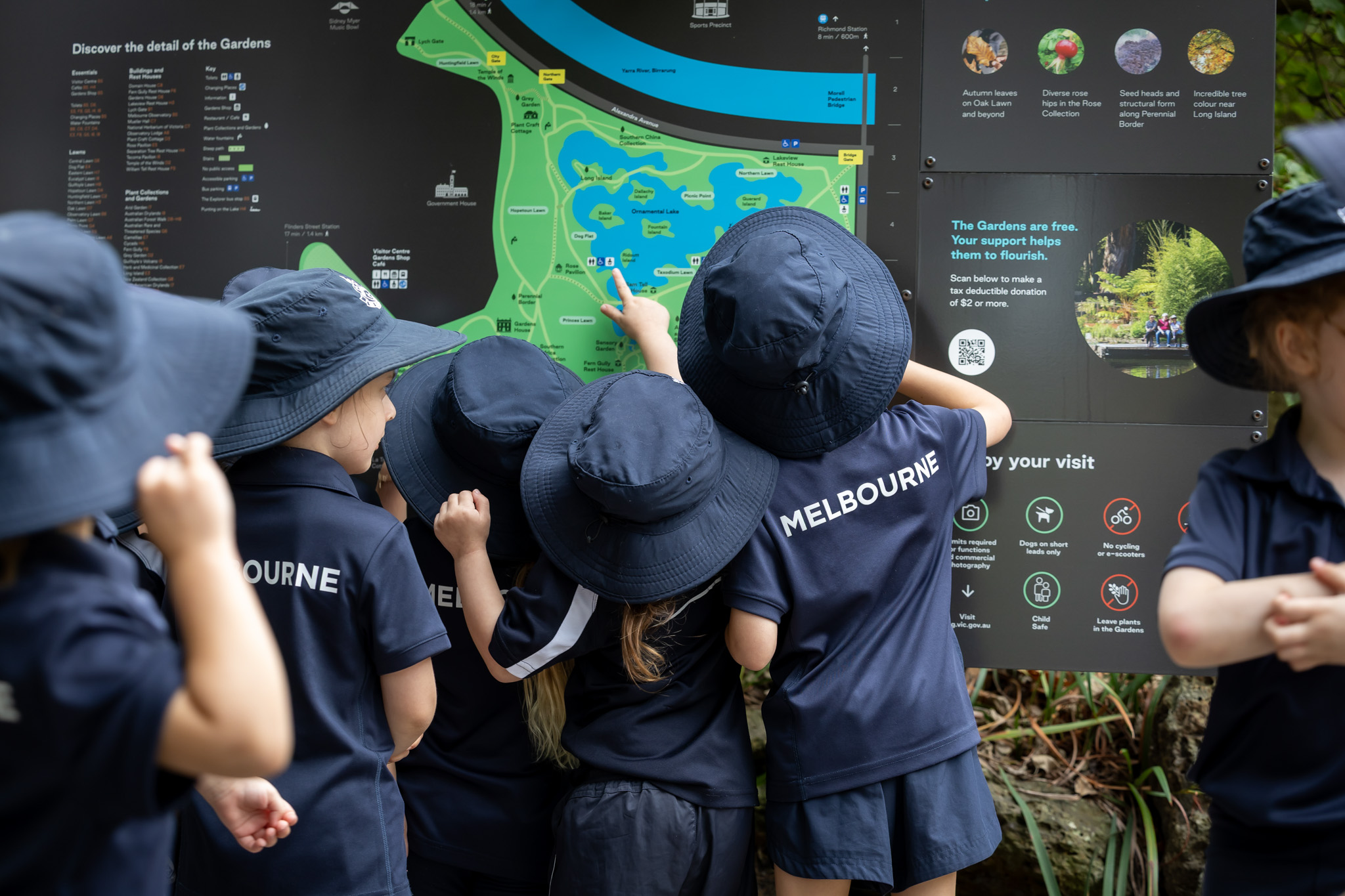
Workshops facilitated by the Gardens educators have further enriched this process, offering sensory, place-responsive experiences that connect children to seasonal changes, plant knowledge and ecological relationships. Whilst both MGGS teacher-led and Royal Botanic Gardens educator-facilitated learning include opportunities for developing literacy, numeracy and scientific thinking – through experiences such as ‘stick letter’ formations, mapping and classification (noticing colour, shape and size) – these are held within meaningful, embodied encounters with place.

Through these encounters, children begin to understand that the Gardens are not just beautiful, but alive with interdependent systems – soil, insects, birds, water and people – all in relationship.

Because of MGGS ELC’s proximity to the Gardens, and as we are truly ‘neighbours’, we have the additional fortune of developing bespoke educational programs in collaboration with the Gardens’ education team. These experiences directly relate to the areas of the Gardens on our north-eastern side and allow for deeper, more sustained learning, as our children visit weekly and already have an established relationship with this place. This is a unique opportunity, most schools travel by bus to the Royal Botanic Gardens’ main education hub near the Ian Potter Children’s Garden, whereas our children engage in ongoing, place-based learning grounded in familiarity, connection and care.

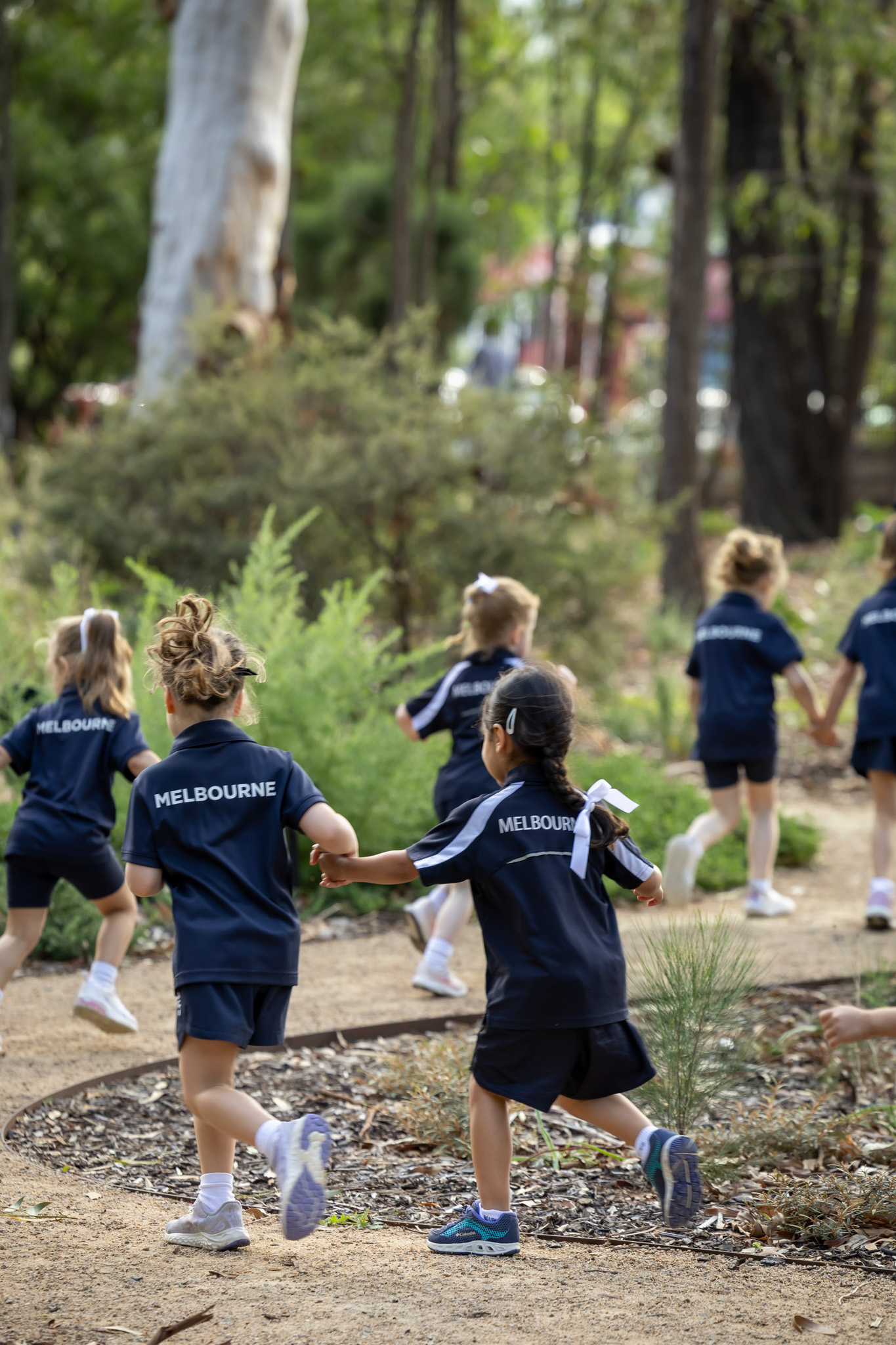
These experiences cultivate more than knowledge, they nurture dispositions. Children develop patience, attentiveness and care. They begin to see themselves as part of a larger ecological story, where their actions matter. In a time of global political, environmental and social precarity, such experiences can also be understood as fostering pedagogies of care, nurturing children’s capacity for attentiveness, responsibility and relational understanding. When a child gently reminds a peer not to step on a plant or pauses to dig around an insect rather than disturb it, we see the emergence of ethical understanding grounded in relationship.

“The Gardens are for everyone.” — Margot, age 4

“We are taught how to live in the whole world.” — Mia, age 4

“This is my best place.” — Kiara, age 4

“I’m 100% happy here.” — Charlotte, age 4
"The Gardens become a vital extension of our learning environment: a place for climbing, building, imagining and connecting, where play and learning are deeply intertwined."

During last year’s ELC inquiry into Place, we drew on First Nations scholar and Noonuccal women Karen Martin’s (2016) concept of Coming Alongside, we approached the Gardens not as something to be explored or used, but as a place we enter into relationship with – respectfully, attentively and with humility. For our four-year-old learners, this is supported through a pedagogy of slowing down, inspired by the First Nations concept of Dadirri – deep listening and quiet, still awareness (Ungunmerr-Baumann et al., 2022). As we walk through the Gardens, we pause often. Children sit with and in trees, watch the movement of water, and listen to birdsong carried by the wind. In these moments, learning is not hurried. Instead, children are invited to attune – to notice the subtle, the seasonal and the relational.

Our work with the Birrarung/Yarra offers another example of Learning with Place. Through visits and ongoing classroom inquiry, the children began to understand the river as a living entity that sustains and connects. In their collaborative clay work, individual pieces were brought together to form a long, flowing river – mirroring the movement of the Birrarung through the Yarra Ranges, Valley and the city. Children observed that “the city needs the river” and began to wonder about its future, including one hot day, whether it might one day be clean enough to swim in. An old Grammarian friend came into to talk to us about the Yarra swimming races she participated in as a student over 60 years ago. These reflections reveal an emerging ecological consciousness grounded in care and interdependence.

Workshops facilitated by the Gardens educators have further enriched this process, offering sensory, place-responsive experiences that connect children to seasonal changes, plant knowledge and ecological relationships. Whilst both MGGS teacher-led and Royal Botanic Gardens educator-facilitated learning include opportunities for developing literacy, numeracy and scientific thinking – through experiences such as ‘stick letter’ formations, mapping and classification (noticing colour, shape and size) – these are held within meaningful, embodied encounters with place.

Through these encounters, children begin to understand that the Gardens are not just beautiful, but alive with interdependent systems – soil, insects, birds, water and people – all in relationship.

Because of MGGS ELC’s proximity to the Gardens, and as we are truly ‘neighbours’, we have the additional fortune of developing bespoke educational programs in collaboration with the Gardens’ education team. These experiences directly relate to the areas of the Gardens on our north-eastern side and allow for deeper, more sustained learning, as our children visit weekly and already have an established relationship with this place. This is a unique opportunity, most schools travel by bus to the Royal Botanic Gardens’ main education hub near the Ian Potter Children’s Garden, whereas our children engage in ongoing, place-based learning grounded in familiarity, connection and care.

These experiences cultivate more than knowledge, they nurture dispositions. Children develop patience, attentiveness and care. They begin to see themselves as part of a larger ecological story, where their actions matter. In a time of global political, environmental and social precarity, such experiences can also be understood as fostering pedagogies of care, nurturing children’s capacity for attentiveness, responsibility and relational understanding. When a child gently reminds a peer not to step on a plant or pauses to dig around an insect rather than disturb it, we see the emergence of ethical understanding grounded in relationship.

“The Gardens are for everyone.” — Margot, age 4

“We are taught how to live in the whole world.” — Mia, age 4

“This is my best place.” — Kiara, age 4

“I’m 100% happy here.” — Charlotte, age 4

"The Gardens become a vital extension of our learning environment: a place for climbing, building, imagining and connecting, where play and learning are deeply intertwined."

During last year’s ELC inquiry into Place, we drew on First Nations scholar and Noonuccal women Karen Martin’s (2016) concept of Coming Alongside, we approached the Gardens not as something to be explored or used, but as a place we enter into relationship with – respectfully, attentively and with humility. For our four-year-old learners, this is supported through a pedagogy of slowing down, inspired by the First Nations concept of Dadirri – deep listening and quiet, still awareness (Ungunmerr-Baumann et al., 2022). As we walk through the Gardens, we pause often. Children sit with and in trees, watch the movement of water, and listen to birdsong carried by the wind. In these moments, learning is not hurried. Instead, children are invited to attune – to notice the subtle, the seasonal and the relational.

Our work with the Birrarung/Yarra offers another example of Learning with Place. Through visits and ongoing classroom inquiry, the children began to understand the river as a living entity that sustains and connects. In their collaborative clay work, individual pieces were brought together to form a long, flowing river – mirroring the movement of the Birrarung through the Yarra Ranges, Valley and the city. Children observed that “the city needs the river” and began to wonder about its future, including one hot day, whether it might one day be clean enough to swim in. An old Grammarian friend came into to talk to us about the Yarra swimming races she participated in as a student over 60 years ago. These reflections reveal an emerging ecological consciousness grounded in care and interdependence.

Workshops facilitated by the Gardens educators have further enriched this process, offering sensory, place-responsive experiences that connect children to seasonal changes, plant knowledge and ecological relationships. Whilst both MGGS teacher-led and Royal Botanic Gardens educator-facilitated learning include opportunities for developing literacy, numeracy and scientific thinking – through experiences such as ‘stick letter’ formations, mapping and classification (noticing colour, shape and size) – these are held within meaningful, embodied encounters with place.

Through these encounters, children begin to understand that the Gardens are not just beautiful, but alive with interdependent systems – soil, insects, birds, water and people – all in relationship.

Because of MGGS ELC’s proximity to the Gardens, and as we are truly ‘neighbours’, we have the additional fortune of developing bespoke educational programs in collaboration with the Gardens’ education team. These experiences directly relate to the areas of the Gardens on our north-eastern side and allow for deeper, more sustained learning, as our children visit weekly and already have an established relationship with this place. This is a unique opportunity, most schools travel by bus to the Royal Botanic Gardens’ main education hub near the Ian Potter Children’s Garden, whereas our children engage in ongoing, place-based learning grounded in familiarity, connection and care.

These experiences cultivate more than knowledge, they nurture dispositions. Children develop patience, attentiveness and care. They begin to see themselves as part of a larger ecological story, where their actions matter. In a time of global political, environmental and social precarity, such experiences can also be understood as fostering pedagogies of care, nurturing children’s capacity for attentiveness, responsibility and relational understanding. When a child gently reminds a peer not to step on a plant or pauses to dig around an insect rather than disturb it, we see the emergence of ethical understanding grounded in relationship.

“The Gardens are for everyone.” — Margot, age 4

“We are taught how to live in the whole world.” — Mia, age 4

“This is my best place.” — Kiara, age 4

“I’m 100% happy here.” — Charlotte, age 4

"Children develop patience, attentiveness and care. They begin to see themselves as part of a larger ecological story, where their actions matter."

Within our relationship with the Royal Botanic Gardens, the significance of the Reggio Emilia ‘pedagogy of relationships and listening’, of co-participation and the pivotal role of the image of the child in educational contexts emerges. By engaging in collaborative endeavours and co-constructing learning experiences with children, educators can foster a more inclusive, respectful and relational learning environment. In the Reggio Emilia approach, the object of education is understood as a relational place, where curiosity is constructed through encounters between children, teachers and things, where all participants “encounter each other” (Giudici et al, 2011, p. 86). This approach reflects the image of the child as competent and strong, rooted in the belief that children are born with an innate desire to understand life and their place within it. They have a right to hope, to be valued and to be heard and school is seen as a place that actively participates in children’s search for meaning as well as in our collective search for shared understandings.  

In a world where learning can sometimes feel abstracted from lived experience, our encounters with the Royal Botanic Gardens offer something profound. Here, learning is embodied, relational and deeply meaningful.

Through Learning with Place and the guiding lens of Coming Alongside, we are supporting our youngest learners to engage with the world not just as observers, but as thoughtful, responsive participants – developing the foundations to become caring custodians of the places they inhabit.

This work reflects the MGGS commitment to Enrich and Engage. Our girls are not simply participating in learning, they are immersed in it. Through regular visits, collaborative workshops with Gardens educators, and sustained relationships with place, they are enriched by experiences that deepen their thinking, spark curiosity and foster a sense of responsibility.

In these moments, we see the beginnings of what it means to be ethical women of action – young learners who are attentive to the world around them, capable of care, and motivated to act with intention and respect within their communities.
"Children develop patience, attentiveness and care. They begin to see themselves as part of a larger ecological story, where their actions matter."

Within our relationship with the Royal Botanic Gardens, the significance of the Reggio Emilia ‘pedagogy of relationships and listening’, of co-participation and the pivotal role of the image of the child in educational contexts emerges. By engaging in collaborative endeavours and co-constructing learning experiences with children, educators can foster a more inclusive, respectful and relational learning environment. In the Reggio Emilia approach, the object of education is understood as a relational place, where curiosity is constructed through encounters between children, teachers and things, where all participants “encounter each other” (Giudici et al, 2011, p. 86). This approach reflects the image of the child as competent and strong, rooted in the belief that children are born with an innate desire to understand life and their place within it. They have a right to hope, to be valued and to be heard and school is seen as a place that actively participates in children’s search for meaning as well as in our collective search for shared understandings.  

In a world where learning can sometimes feel abstracted from lived experience, our encounters with the Royal Botanic Gardens offer something profound. Here, learning is embodied, relational and deeply meaningful.

Through Learning with Place and the guiding lens of Coming Alongside, we are supporting our youngest learners to engage with the world not just as observers, but as thoughtful, responsive participants – developing the foundations to become caring custodians of the places they inhabit.

This work reflects the MGGS commitment to Enrich and Engage. Our girls are not simply participating in learning, they are immersed in it. Through regular visits, collaborative workshops with Gardens educators, and sustained relationships with place, they are enriched by experiences that deepen their thinking, spark curiosity and foster a sense of responsibility.

In these moments, we see the beginnings of what it means to be ethical women of action – young learners who are attentive to the world around them, capable of care, and motivated to act with intention and respect within their communities.
"Children develop patience, attentiveness and care. They begin to see themselves as part of a larger ecological story, where their actions matter."

Within our relationship with the Royal Botanic Gardens, the significance of the Reggio Emilia ‘pedagogy of relationships and listening’, of co-participation and the pivotal role of the image of the child in educational contexts emerges. By engaging in collaborative endeavours and co-constructing learning experiences with children, educators can foster a more inclusive, respectful and relational learning environment. In the Reggio Emilia approach, the object of education is understood as a relational place, where curiosity is constructed through encounters between children, teachers and things, where all participants “encounter each other” (Giudici et al, 2011, p. 86). This approach reflects the image of the child as competent and strong, rooted in the belief that children are born with an innate desire to understand life and their place within it. They have a right to hope, to be valued and to be heard and school is seen as a place that actively participates in children’s search for meaning as well as in our collective search for shared understandings.  

In a world where learning can sometimes feel abstracted from lived experience, our encounters with the Royal Botanic Gardens offer something profound. Here, learning is embodied, relational and deeply meaningful.

Through Learning with Place and the guiding lens of Coming Alongside, we are supporting our youngest learners to engage with the world not just as observers, but as thoughtful, responsive participants – developing the foundations to become caring custodians of the places they inhabit.

This work reflects the MGGS commitment to Enrich and Engage. Our girls are not simply participating in learning, they are immersed in it. Through regular visits, collaborative workshops with Gardens educators, and sustained relationships with place, they are enriched by experiences that deepen their thinking, spark curiosity and foster a sense of responsibility.

In these moments, we see the beginnings of what it means to be ethical women of action – young learners who are attentive to the world around them, capable of care, and motivated to act with intention and respect within their communities.
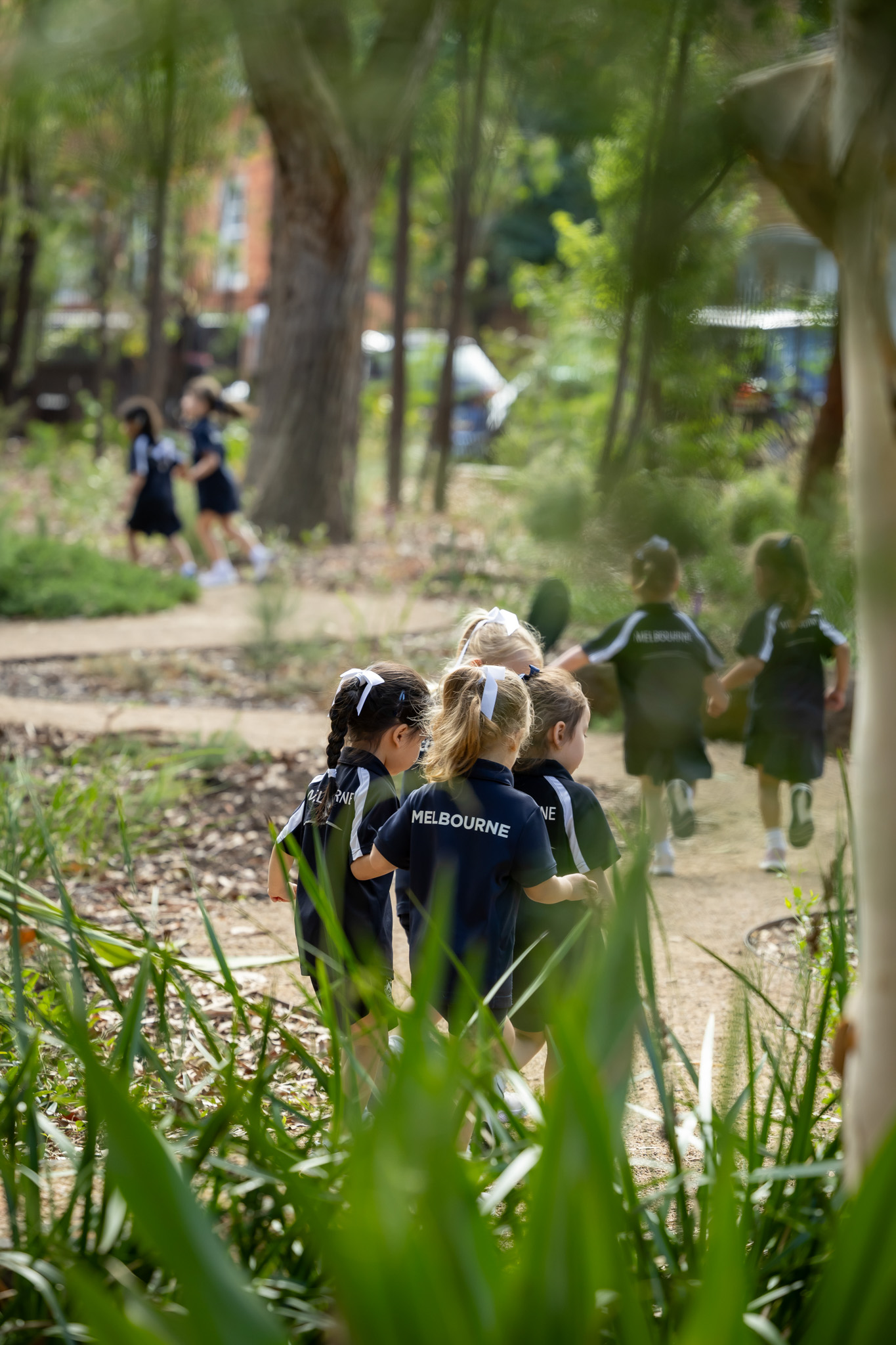
ELC students exploring the Royal Botanic Gardens
ELC students Navigating the Royal Botanic Gardens Using a Map
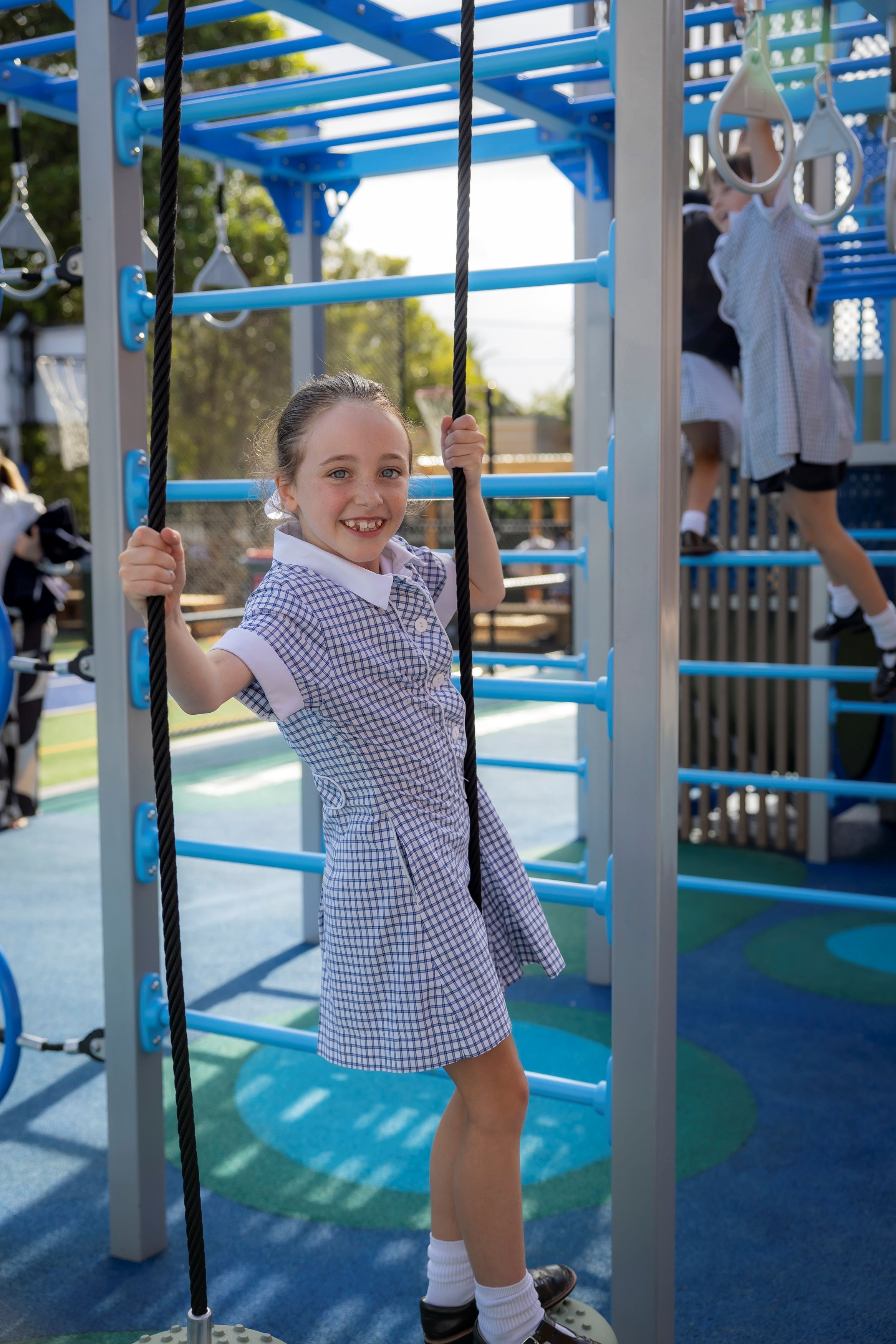
Two ELC students supporting each other in active play
ELC students playing in the Royal Botanic Gardens' Environment
ELC students exploring the Royal Botanic Gardens
No items found.
No items found.
No items found.
No items found.

References

Giudici, C., & Barchi, P. (Eds.). (2011). Making Learning Visible: Children as individual and Group Learners; RE PZ (5. Printing) Reggio Children
Iorio, J. M., & Hamm, C. (2021). Learning with Place: Innovative Pedagogies for Climate Action. In The SAGE Handbook of Global Childhoods, edited by N. Yelland, L. Peters, N. Fairchild, M. Tesar, and M.J. Pérez, 321-331. London. United Kingdom. Sage.
Martin, K. (2016). Voices and Visions: Aboriginal Early Childhood Education in Australia. Jamberoo, NSW, Australia: Pademelon Press
Ungunmerr-Baumann, M.-R., Groom, R. A., Schuberg, E. L., Atkinson, J., Atkinson, C., Wallace, R., & Morris, G. (2022).
Dadirri: An Indigenous place-based research

References

Giudici, C., & Barchi, P. (Eds.). (2011). Making Learning Visible: Children as individual and Group Learners; RE PZ (5. Printing) Reggio Children
Iorio, J. M., & Hamm, C. (2021). Learning with Place: Innovative Pedagogies for Climate Action. In The SAGE Handbook of Global Childhoods, edited by N. Yelland, L. Peters, N. Fairchild, M. Tesar, and M.J. Pérez, 321-331. London. United Kingdom. Sage.
Martin, K. (2016). Voices and Visions: Aboriginal Early Childhood Education in Australia. Jamberoo, NSW, Australia: Pademelon Press
Ungunmerr-Baumann, M.-R., Groom, R. A., Schuberg, E. L., Atkinson, J., Atkinson, C., Wallace, R., & Morris, G. (2022).
Dadirri: An Indigenous place-based research

No items found.
No items found.
No items found.
No items found.
No items found.
03

Learning with Place

At Melbourne Girls Grammar Early Learning Centre, the ripples of our learning extend far beyond the classroom walls, unfolding through our relationships with the wider community. Our regular visits across the road to the Royal Botanic Gardens create rich opportunities for children and teachers to engage with the living world – sparking curiosity, wonder and a deepening sense of connection. In these moments, children are not simply learning about nature; they are learning with it, as they begin to see themselves as part of a shared and living world.

Our relationship with the Royal Botanic Gardens is not new. For over a century, MGGS students have formed close connections with this incredible place. In today’s context, this relationship holds renewed significance. In an era shaped by climate change, environmental degradation and the ongoing legacies of colonialism, the Gardens can be understood as a pedagogical contact zone – one that calls for ecological literacy, relational ethics and diverse ways of knowing and being.

This is what we describe as Learning with Place. Drawing on the Learning with Place© framework developed by Iorio and Hamm at the University of Melbourne, this approach foregrounds reciprocity, interconnectedness and respect, recognising that children, teachers and schools are deeply entangled with the land, environment and community in which they learn.

A growing number of our children are growing up in apartments in and around the city, with limited access to expansive natural play environments. As a five-day-a-week early learning centre, this means that MGGS ELC teachers enact deep care for the wellbeing for students through responsive curriculum development, by thoughtfully designing opportunities that meet children’s developmental, physical and creative needs. In this sense, our engagement with the Gardens aligns with principles drawn from play theories – offering children access to rich, open-ended environments where they can explore, have adventures, create and encounter the unexpected (think swans with cygnets and owlets, giant water lillies and sparkly rain drop covered spiderwebs). The Gardens become a vital extension of our learning environment: a place for climbing, building, imagining and connecting, where play and learning are deeply intertwined. In this way, MGGS’s ongoing and enduring relationship with the Royal Botanic Gardens offers children the kind of rich, connected and wonder-filled childhood we wish for all children, everywhere.

Our relationship with the Royal Botanic Gardens is not new. For over a century, MGGS students have formed close connections with this incredible place. In today’s context, this relationship holds renewed significance. In an era shaped by climate change, environmental degradation and the ongoing legacies of colonialism, the Gardens can be understood as a pedagogical contact zone – one that calls for ecological literacy, relational ethics and diverse ways of knowing and being.

This is what we describe as Learning with Place. Drawing on the Learning with Place© framework developed by Iorio and Hamm at the University of Melbourne, this approach foregrounds reciprocity, interconnectedness and respect, recognising that children, teachers and schools are deeply entangled with the land, environment and community in which they learn.

A growing number of our children are growing up in apartments in and around the city, with limited access to expansive natural play environments. As a five-day-a-week early learning centre, this means that MGGS ELC teachers enact deep care for the wellbeing for students through responsive curriculum development, by thoughtfully designing opportunities that meet children’s developmental, physical and creative needs. In this sense, our engagement with the Gardens aligns with principles drawn from play theories – offering children access to rich, open-ended environments where they can explore, have adventures, create and encounter the unexpected (think swans with cygnets and owlets, giant water lillies and sparkly rain drop covered spiderwebs). The Gardens become a vital extension of our learning environment: a place for climbing, building, imagining and connecting, where play and learning are deeply intertwined. In this way, MGGS’s ongoing and enduring relationship with the Royal Botanic Gardens offers children the kind of rich, connected and wonder-filled childhood we wish for all children, everywhere.

Our relationship with the Royal Botanic Gardens is not new. For over a century, MGGS students have formed close connections with this incredible place. In today’s context, this relationship holds renewed significance. In an era shaped by climate change, environmental degradation and the ongoing legacies of colonialism, the Gardens can be understood as a pedagogical contact zone – one that calls for ecological literacy, relational ethics and diverse ways of knowing and being.

This is what we describe as Learning with Place. Drawing on the Learning with Place© framework developed by Iorio and Hamm at the University of Melbourne, this approach foregrounds reciprocity, interconnectedness and respect, recognising that children, teachers and schools are deeply entangled with the land, environment and community in which they learn.

A growing number of our children are growing up in apartments in and around the city, with limited access to expansive natural play environments. As a five-day-a-week early learning centre, this means that MGGS ELC teachers enact deep care for the wellbeing for students through responsive curriculum development, by thoughtfully designing opportunities that meet children’s developmental, physical and creative needs. In this sense, our engagement with the Gardens aligns with principles drawn from play theories – offering children access to rich, open-ended environments where they can explore, have adventures, create and encounter the unexpected (think swans with cygnets and owlets, giant water lillies and sparkly rain drop covered spiderwebs). The Gardens become a vital extension of our learning environment: a place for climbing, building, imagining and connecting, where play and learning are deeply intertwined. In this way, MGGS’s ongoing and enduring relationship with the Royal Botanic Gardens offers children the kind of rich, connected and wonder-filled childhood we wish for all children, everywhere.

No items found.
"The Gardens become a vital extension of our learning environment: a place for climbing, building, imagining and connecting, where play and learning are deeply intertwined."

During last year’s ELC inquiry into Place, we drew on First Nations scholar and Noonuccal women Karen Martin’s (2016) concept of Coming Alongside, we approached the Gardens not as something to be explored or used, but as a place we enter into relationship with – respectfully, attentively and with humility. For our four-year-old learners, this is supported through a pedagogy of slowing down, inspired by the First Nations concept of Dadirri – deep listening and quiet, still awareness (Ungunmerr-Baumann et al., 2022). As we walk through the Gardens, we pause often. Children sit with and in trees, watch the movement of water, and listen to birdsong carried by the wind. In these moments, learning is not hurried. Instead, children are invited to attune – to notice the subtle, the seasonal and the relational.

Our work with the Birrarung/Yarra offers another example of Learning with Place. Through visits and ongoing classroom inquiry, the children began to understand the river as a living entity that sustains and connects. In their collaborative clay work, individual pieces were brought together to form a long, flowing river – mirroring the movement of the Birrarung through the Yarra Ranges, Valley and the city. Children observed that “the city needs the river” and began to wonder about its future, including one hot day, whether it might one day be clean enough to swim in. An old Grammarian friend came into to talk to us about the Yarra swimming races she participated in as a student over 60 years ago. These reflections reveal an emerging ecological consciousness grounded in care and interdependence.

Workshops facilitated by the Gardens educators have further enriched this process, offering sensory, place-responsive experiences that connect children to seasonal changes, plant knowledge and ecological relationships. Whilst both MGGS teacher-led and Royal Botanic Gardens educator-facilitated learning include opportunities for developing literacy, numeracy and scientific thinking – through experiences such as ‘stick letter’ formations, mapping and classification (noticing colour, shape and size) – these are held within meaningful, embodied encounters with place.

Through these encounters, children begin to understand that the Gardens are not just beautiful, but alive with interdependent systems – soil, insects, birds, water and people – all in relationship.

Because of MGGS ELC’s proximity to the Gardens, and as we are truly ‘neighbours’, we have the additional fortune of developing bespoke educational programs in collaboration with the Gardens’ education team. These experiences directly relate to the areas of the Gardens on our north-eastern side and allow for deeper, more sustained learning, as our children visit weekly and already have an established relationship with this place. This is a unique opportunity, most schools travel by bus to the Royal Botanic Gardens’ main education hub near the Ian Potter Children’s Garden, whereas our children engage in ongoing, place-based learning grounded in familiarity, connection and care.

These experiences cultivate more than knowledge, they nurture dispositions. Children develop patience, attentiveness and care. They begin to see themselves as part of a larger ecological story, where their actions matter. In a time of global political, environmental and social precarity, such experiences can also be understood as fostering pedagogies of care, nurturing children’s capacity for attentiveness, responsibility and relational understanding. When a child gently reminds a peer not to step on a plant or pauses to dig around an insect rather than disturb it, we see the emergence of ethical understanding grounded in relationship.

“The Gardens are for everyone.” — Margot, age 4

“We are taught how to live in the whole world.” — Mia, age 4

“This is my best place.” — Kiara, age 4

“I’m 100% happy here.” — Charlotte, age 4

"The Gardens become a vital extension of our learning environment: a place for climbing, building, imagining and connecting, where play and learning are deeply intertwined."

During last year’s ELC inquiry into Place, we drew on First Nations scholar and Noonuccal women Karen Martin’s (2016) concept of Coming Alongside, we approached the Gardens not as something to be explored or used, but as a place we enter into relationship with – respectfully, attentively and with humility. For our four-year-old learners, this is supported through a pedagogy of slowing down, inspired by the First Nations concept of Dadirri – deep listening and quiet, still awareness (Ungunmerr-Baumann et al., 2022). As we walk through the Gardens, we pause often. Children sit with and in trees, watch the movement of water, and listen to birdsong carried by the wind. In these moments, learning is not hurried. Instead, children are invited to attune – to notice the subtle, the seasonal and the relational.

Our work with the Birrarung/Yarra offers another example of Learning with Place. Through visits and ongoing classroom inquiry, the children began to understand the river as a living entity that sustains and connects. In their collaborative clay work, individual pieces were brought together to form a long, flowing river – mirroring the movement of the Birrarung through the Yarra Ranges, Valley and the city. Children observed that “the city needs the river” and began to wonder about its future, including one hot day, whether it might one day be clean enough to swim in. An old Grammarian friend came into to talk to us about the Yarra swimming races she participated in as a student over 60 years ago. These reflections reveal an emerging ecological consciousness grounded in care and interdependence.

Workshops facilitated by the Gardens educators have further enriched this process, offering sensory, place-responsive experiences that connect children to seasonal changes, plant knowledge and ecological relationships. Whilst both MGGS teacher-led and Royal Botanic Gardens educator-facilitated learning include opportunities for developing literacy, numeracy and scientific thinking – through experiences such as ‘stick letter’ formations, mapping and classification (noticing colour, shape and size) – these are held within meaningful, embodied encounters with place.

Through these encounters, children begin to understand that the Gardens are not just beautiful, but alive with interdependent systems – soil, insects, birds, water and people – all in relationship.

Because of MGGS ELC’s proximity to the Gardens, and as we are truly ‘neighbours’, we have the additional fortune of developing bespoke educational programs in collaboration with the Gardens’ education team. These experiences directly relate to the areas of the Gardens on our north-eastern side and allow for deeper, more sustained learning, as our children visit weekly and already have an established relationship with this place. This is a unique opportunity, most schools travel by bus to the Royal Botanic Gardens’ main education hub near the Ian Potter Children’s Garden, whereas our children engage in ongoing, place-based learning grounded in familiarity, connection and care.

These experiences cultivate more than knowledge, they nurture dispositions. Children develop patience, attentiveness and care. They begin to see themselves as part of a larger ecological story, where their actions matter. In a time of global political, environmental and social precarity, such experiences can also be understood as fostering pedagogies of care, nurturing children’s capacity for attentiveness, responsibility and relational understanding. When a child gently reminds a peer not to step on a plant or pauses to dig around an insect rather than disturb it, we see the emergence of ethical understanding grounded in relationship.

“The Gardens are for everyone.” — Margot, age 4

“We are taught how to live in the whole world.” — Mia, age 4

“This is my best place.” — Kiara, age 4

“I’m 100% happy here.” — Charlotte, age 4

"The Gardens become a vital extension of our learning environment: a place for climbing, building, imagining and connecting, where play and learning are deeply intertwined."

During last year’s ELC inquiry into Place, we drew on First Nations scholar and Noonuccal women Karen Martin’s (2016) concept of Coming Alongside, we approached the Gardens not as something to be explored or used, but as a place we enter into relationship with – respectfully, attentively and with humility. For our four-year-old learners, this is supported through a pedagogy of slowing down, inspired by the First Nations concept of Dadirri – deep listening and quiet, still awareness (Ungunmerr-Baumann et al., 2022). As we walk through the Gardens, we pause often. Children sit with and in trees, watch the movement of water, and listen to birdsong carried by the wind. In these moments, learning is not hurried. Instead, children are invited to attune – to notice the subtle, the seasonal and the relational.

Our work with the Birrarung/Yarra offers another example of Learning with Place. Through visits and ongoing classroom inquiry, the children began to understand the river as a living entity that sustains and connects. In their collaborative clay work, individual pieces were brought together to form a long, flowing river – mirroring the movement of the Birrarung through the Yarra Ranges, Valley and the city. Children observed that “the city needs the river” and began to wonder about its future, including one hot day, whether it might one day be clean enough to swim in. An old Grammarian friend came into to talk to us about the Yarra swimming races she participated in as a student over 60 years ago. These reflections reveal an emerging ecological consciousness grounded in care and interdependence.

Workshops facilitated by the Gardens educators have further enriched this process, offering sensory, place-responsive experiences that connect children to seasonal changes, plant knowledge and ecological relationships. Whilst both MGGS teacher-led and Royal Botanic Gardens educator-facilitated learning include opportunities for developing literacy, numeracy and scientific thinking – through experiences such as ‘stick letter’ formations, mapping and classification (noticing colour, shape and size) – these are held within meaningful, embodied encounters with place.

Through these encounters, children begin to understand that the Gardens are not just beautiful, but alive with interdependent systems – soil, insects, birds, water and people – all in relationship.

Because of MGGS ELC’s proximity to the Gardens, and as we are truly ‘neighbours’, we have the additional fortune of developing bespoke educational programs in collaboration with the Gardens’ education team. These experiences directly relate to the areas of the Gardens on our north-eastern side and allow for deeper, more sustained learning, as our children visit weekly and already have an established relationship with this place. This is a unique opportunity, most schools travel by bus to the Royal Botanic Gardens’ main education hub near the Ian Potter Children’s Garden, whereas our children engage in ongoing, place-based learning grounded in familiarity, connection and care.

These experiences cultivate more than knowledge, they nurture dispositions. Children develop patience, attentiveness and care. They begin to see themselves as part of a larger ecological story, where their actions matter. In a time of global political, environmental and social precarity, such experiences can also be understood as fostering pedagogies of care, nurturing children’s capacity for attentiveness, responsibility and relational understanding. When a child gently reminds a peer not to step on a plant or pauses to dig around an insect rather than disturb it, we see the emergence of ethical understanding grounded in relationship.

“The Gardens are for everyone.” — Margot, age 4

“We are taught how to live in the whole world.” — Mia, age 4

“This is my best place.” — Kiara, age 4

“I’m 100% happy here.” — Charlotte, age 4

"Children develop patience, attentiveness and care. They begin to see themselves as part of a larger ecological story, where their actions matter."

Within our relationship with the Royal Botanic Gardens, the significance of the Reggio Emilia ‘pedagogy of relationships and listening’, of co-participation and the pivotal role of the image of the child in educational contexts emerges. By engaging in collaborative endeavours and co-constructing learning experiences with children, educators can foster a more inclusive, respectful and relational learning environment. In the Reggio Emilia approach, the object of education is understood as a relational place, where curiosity is constructed through encounters between children, teachers and things, where all participants “encounter each other” (Giudici et al, 2011, p. 86). This approach reflects the image of the child as competent and strong, rooted in the belief that children are born with an innate desire to understand life and their place within it. They have a right to hope, to be valued and to be heard and school is seen as a place that actively participates in children’s search for meaning as well as in our collective search for shared understandings.  

In a world where learning can sometimes feel abstracted from lived experience, our encounters with the Royal Botanic Gardens offer something profound. Here, learning is embodied, relational and deeply meaningful.

Through Learning with Place and the guiding lens of Coming Alongside, we are supporting our youngest learners to engage with the world not just as observers, but as thoughtful, responsive participants – developing the foundations to become caring custodians of the places they inhabit.

This work reflects the MGGS commitment to Enrich and Engage. Our girls are not simply participating in learning, they are immersed in it. Through regular visits, collaborative workshops with Gardens educators, and sustained relationships with place, they are enriched by experiences that deepen their thinking, spark curiosity and foster a sense of responsibility.

In these moments, we see the beginnings of what it means to be ethical women of action – young learners who are attentive to the world around them, capable of care, and motivated to act with intention and respect within their communities.

"Children develop patience, attentiveness and care. They begin to see themselves as part of a larger ecological story, where their actions matter."

Within our relationship with the Royal Botanic Gardens, the significance of the Reggio Emilia ‘pedagogy of relationships and listening’, of co-participation and the pivotal role of the image of the child in educational contexts emerges. By engaging in collaborative endeavours and co-constructing learning experiences with children, educators can foster a more inclusive, respectful and relational learning environment. In the Reggio Emilia approach, the object of education is understood as a relational place, where curiosity is constructed through encounters between children, teachers and things, where all participants “encounter each other” (Giudici et al, 2011, p. 86). This approach reflects the image of the child as competent and strong, rooted in the belief that children are born with an innate desire to understand life and their place within it. They have a right to hope, to be valued and to be heard and school is seen as a place that actively participates in children’s search for meaning as well as in our collective search for shared understandings.  

In a world where learning can sometimes feel abstracted from lived experience, our encounters with the Royal Botanic Gardens offer something profound. Here, learning is embodied, relational and deeply meaningful.

Through Learning with Place and the guiding lens of Coming Alongside, we are supporting our youngest learners to engage with the world not just as observers, but as thoughtful, responsive participants – developing the foundations to become caring custodians of the places they inhabit.

This work reflects the MGGS commitment to Enrich and Engage. Our girls are not simply participating in learning, they are immersed in it. Through regular visits, collaborative workshops with Gardens educators, and sustained relationships with place, they are enriched by experiences that deepen their thinking, spark curiosity and foster a sense of responsibility.

In these moments, we see the beginnings of what it means to be ethical women of action – young learners who are attentive to the world around them, capable of care, and motivated to act with intention and respect within their communities.

"Children develop patience, attentiveness and care. They begin to see themselves as part of a larger ecological story, where their actions matter."

Within our relationship with the Royal Botanic Gardens, the significance of the Reggio Emilia ‘pedagogy of relationships and listening’, of co-participation and the pivotal role of the image of the child in educational contexts emerges. By engaging in collaborative endeavours and co-constructing learning experiences with children, educators can foster a more inclusive, respectful and relational learning environment. In the Reggio Emilia approach, the object of education is understood as a relational place, where curiosity is constructed through encounters between children, teachers and things, where all participants “encounter each other” (Giudici et al, 2011, p. 86). This approach reflects the image of the child as competent and strong, rooted in the belief that children are born with an innate desire to understand life and their place within it. They have a right to hope, to be valued and to be heard and school is seen as a place that actively participates in children’s search for meaning as well as in our collective search for shared understandings.  

In a world where learning can sometimes feel abstracted from lived experience, our encounters with the Royal Botanic Gardens offer something profound. Here, learning is embodied, relational and deeply meaningful.

Through Learning with Place and the guiding lens of Coming Alongside, we are supporting our youngest learners to engage with the world not just as observers, but as thoughtful, responsive participants – developing the foundations to become caring custodians of the places they inhabit.

This work reflects the MGGS commitment to Enrich and Engage. Our girls are not simply participating in learning, they are immersed in it. Through regular visits, collaborative workshops with Gardens educators, and sustained relationships with place, they are enriched by experiences that deepen their thinking, spark curiosity and foster a sense of responsibility.

In these moments, we see the beginnings of what it means to be ethical women of action – young learners who are attentive to the world around them, capable of care, and motivated to act with intention and respect within their communities.

No items found.
Close
Close
Close
Close
Close
Close
Close
Close
Close
Close
ELC students exploring the Royal Botanic Gardens
ELC students Navigating the Royal Botanic Gardens Using a Map
Two ELC students supporting each other in active play
ELC students playing in the Royal Botanic Gardens' Environment
ELC students exploring the Royal Botanic Gardens
Prev
Next
ELC students exploring the Royal Botanic Gardens
ELC students Navigating the Royal Botanic Gardens Using a Map
Two ELC students supporting each other in active play
ELC students playing in the Royal Botanic Gardens' Environment
ELC students exploring the Royal Botanic Gardens
Prev
Next

References

Giudici, C., & Barchi, P. (Eds.). (2011). Making Learning Visible: Children as individual and Group Learners; RE PZ (5. Printing) Reggio Children
Iorio, J. M., & Hamm, C. (2021). Learning with Place: Innovative Pedagogies for Climate Action. In The SAGE Handbook of Global Childhoods, edited by N. Yelland, L. Peters, N. Fairchild, M. Tesar, and M.J. Pérez, 321-331. London. United Kingdom. Sage.
Martin, K. (2016). Voices and Visions: Aboriginal Early Childhood Education in Australia. Jamberoo, NSW, Australia: Pademelon Press
Ungunmerr-Baumann, M.-R., Groom, R. A., Schuberg, E. L., Atkinson, J., Atkinson, C., Wallace, R., & Morris, G. (2022).
Dadirri: An Indigenous place-based research

References

Giudici, C., & Barchi, P. (Eds.). (2011). Making Learning Visible: Children as individual and Group Learners; RE PZ (5. Printing) Reggio Children
Iorio, J. M., & Hamm, C. (2021). Learning with Place: Innovative Pedagogies for Climate Action. In The SAGE Handbook of Global Childhoods, edited by N. Yelland, L. Peters, N. Fairchild, M. Tesar, and M.J. Pérez, 321-331. London. United Kingdom. Sage.
Martin, K. (2016). Voices and Visions: Aboriginal Early Childhood Education in Australia. Jamberoo, NSW, Australia: Pademelon Press
Ungunmerr-Baumann, M.-R., Groom, R. A., Schuberg, E. L., Atkinson, J., Atkinson, C., Wallace, R., & Morris, G. (2022).
Dadirri: An Indigenous place-based research

No items found.
No items found.
No items found.
}